Companies
Onboarding and internal training built on the processes and documentation the organisation already has.
SkillNet turns an idea or a source into a course that can adapt its explanations, activities and interface to each person.
SkillNet is an open source adaptive learning system. It starts from what you want to teach and builds a complete course: it organises the content, writes the lessons and the exercises, and keeps the link back to the sources it used. On that same base, it can adapt the explanation, the practice and the interface to each person's context without changing the learning objective.
A course starts from shared knowledge and shared objectives. From there, each person's declared preferences, role, level and progress act as signals for deciding which explanation, activity, support or interface to show. They are hypotheses that can change, not fixed labels about how someone learns.
What changes is what we already know, the context, the pace and the support we need. The same idea may need another explanation, another example, or a different way to practise it.
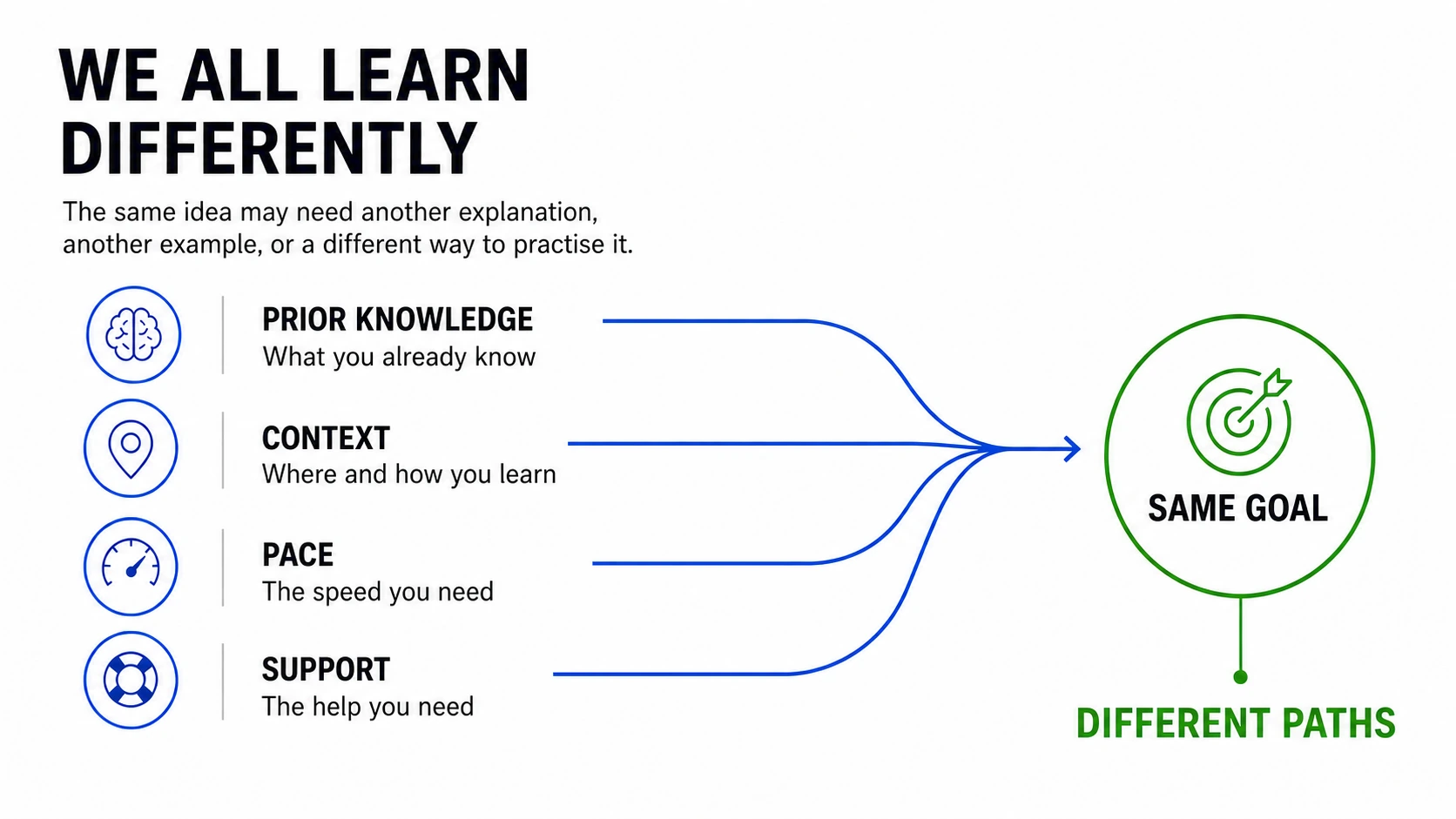
“We all learn differently…”
Format is only one part. The explanation, the practice and the interface can change too.
“You cannot judge a fish by how it climbs a tree.”
The same goal does not force the same path. One person may need a different example, more context, a different exercise, or an interface that lets them explore the idea. Personalising is not about changing what is learned, but about adapting how someone comes to understand it.
The system is the same in all three cases. What changes is who decides what has to be learned, and how much room each person has to get there their own way.
Onboarding and internal training built on the processes and documentation the organisation already has.
Classes and materials that keep shared objectives while each student's experience changes.
Learning on your own, at the pace and level of detail you need.
SkillNet is built in the open: the code can be reviewed, run and improved publicly. It is self-hosted, with the AI provider you choose or with local models, and its API, the A2A service and the MCP server let you use it from other tools. Apache 2.0 licence.
Many new technologies start out imitating the ones before them. The first cars looked like carriages, and the first web pages moved paper onto a screen. What if something similar is happening to a good part of digital education, with books, classes and linear paths carried onto the internet without really changing the experience? If so, artificial intelligence opens up the possibility of looking for a language of its own for learning, always as a tool at the service of teachers and students.
SkillNet already works in that direction. It generates interfaces with OpenUI and composes them with Didact components made for learning. Declared preferences, role, level and progress can change the presentation, the activities and the support that appear in a course.
The next frontier is generating the interactive experience itself, as well as choosing between existing formats. With today's models, doing this well is still expensive and slow. As they evolve, they will be able to create more complex interfaces in less time and at a lower cost, making this kind of generation viable for more courses and more learners.
An animation course could go beyond showing a video about animation: it could also generate a frame simulator so each person can experiment directly. That is not viable at scale yet, but it is the direction SkillNet wants to explore.
SkillNet shares an ecosystem with two other open projects that form part of its learning experience.
SkillNet is still in development. If the idea interests you, you can try it, tell me what you would improve, or contribute to the project directly.
Developed under
ANFAIA 2026 grant, sponsored by